
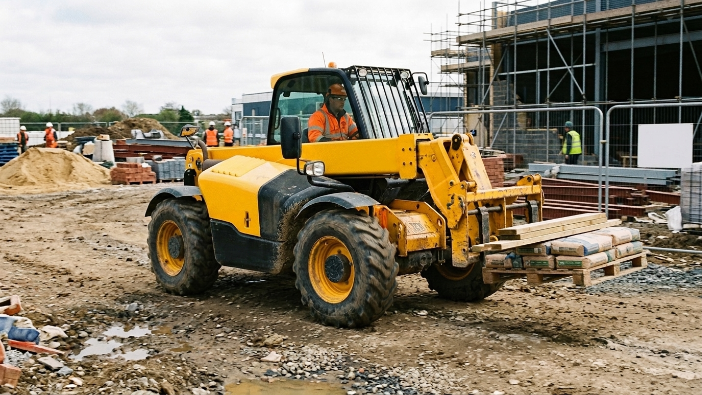
A standard counterbalance forklift performs reliably on smooth, sealed warehouse floors. Take it onto a muddy construction site, a gravel yard, or an uneven rural property and it quickly becomes a liability rather than an asset. Rough terrain forklift hire exists precisely for these environments, providing machines built with the traction, ground clearance, and stability to lift and move loads in the kinds of conditions that defeat conventional materials handling equipment.
What Sets Rough Terrain Forklifts Apart
The physical differences between a rough terrain forklift and a standard warehouse unit are significant and purpose-driven. Rough terrain machines ride on large pneumatic tyres with deep, aggressive tread patterns designed to grip loose, wet, or uneven surfaces. The chassis sits higher off the ground to clear obstacles that would ground a conventional forklift. The powertrain is typically diesel-driven to provide the torque needed for soft ground operation, and the hydraulic systems are designed to maintain performance on slopes and uneven surfaces where a standard machine would struggle with stability.
Four-wheel drive is standard on most rough terrain models, distributing drive force across all wheels to prevent the bogging that affects two-wheel drive machines in soft or slippery conditions. Some models also feature oscillating rear axles that allow the rear wheels to follow ground contours independently, maintaining four points of contact on surfaces that would otherwise tip a rigid chassis machine.
Applications Where This Equipment Is Most Commonly Used
Rough terrain forklift hire is most frequently requested for environments where site conditions are genuinely challenging. These include:
- Construction sites where materials need to be moved across uncompacted ground, gravel, or temporary road surfaces
- Agricultural properties handling large bales, palletised goods, or equipment in paddock or yard environments
- Mining and resource extraction sites where surface conditions change constantly and loads are heavy
- Outdoor events and festivals where temporary infrastructure needs to be moved across grass or soft ground
- Timber and logging operations where the working surface is rarely level or stable
- Rural and remote locations where infrastructure is minimal and the ground underfoot reflects natural terrain
Hire vs Purchase for Rough Terrain Forklifts
The decision between hiring and purchasing a rough terrain forklift comes down to how often the equipment is genuinely needed and whether the site conditions that require it are ongoing or project-specific. For businesses with a permanent need for rough terrain capability, ownership may make financial sense over time. For project-based work, seasonal applications, or situations where the need arises infrequently, rough terrain forklift hire consistently produces a better outcome by providing the right machine for the duration it is needed without the capital cost, maintenance obligations, and storage requirements of ownership.
Hire also provides access to a range of machine sizes and configurations matched to specific job requirements, rather than locking the operator into a single unit that may be undersized for some jobs and underutilised for others.
Licence and Operator Requirements
Operating a rough terrain forklift in Australia requires the operator to hold a valid High Risk Work licence for forklift operation, issued by the relevant state work health and safety authority. This requirement applies regardless of whether the machine is hired or owned, and regardless of whether it is being operated on a public or private site.
When engaging rough terrain forklift hire for a project, confirming that all operators who will use the machine hold current licences is an important step before the machine arrives on site. Hire providers can supply the machine and may be able to arrange an experienced operator through a wet hire arrangement, but the responsibility for ensuring compliance with operator licencing requirements sits with the person or business controlling the work on site.
What to Confirm Before the Machine Arrives
A rough terrain forklift that is the wrong size for the load, or that cannot access the working area due to overhead clearances or ground conditions more severe than the machine is rated for, creates problems on the day that could have been avoided with better planning. Before confirming a hire, it is worth establishing the maximum load weight and lift height required, the ground conditions across the working area, any overhead restrictions at the site, the required attachment type for the loads being handled, and the access route for delivering and collecting the machine. Providing this information to the hire provider at the quoting stage is what ensures the machine supplied is genuinely suited to the job it will be asked to do.